 77,000+ Tools Available Online
 Quality Tools for Every Project
 Fast Shipping on Thousands of Items
 Expert Service & Support
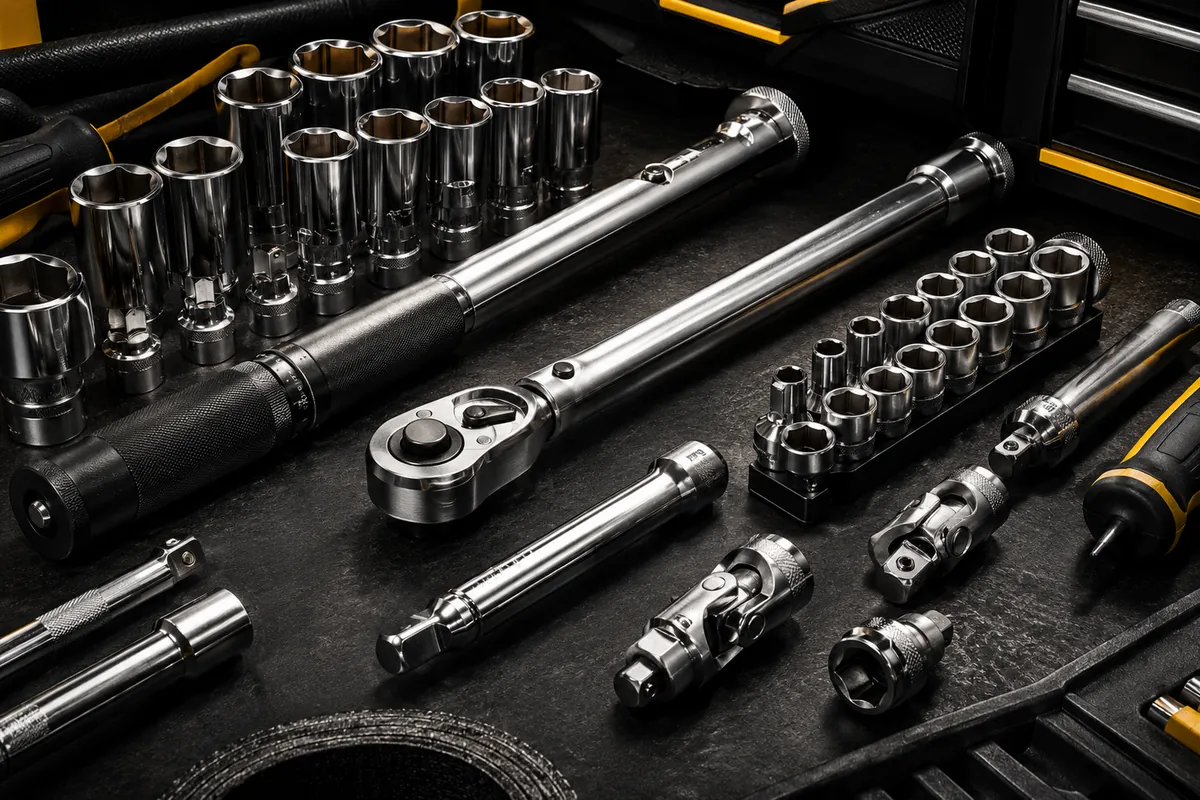
Walk through any professional shop and you’ll find two types of sockets in nearly every toolbox: chrome-finished hand-tool sockets and matte black impact sockets. They look similar enough that it’s easy to grab the wrong one in a hurry. That’s a mistake you do not want to make. These two tools are built from different metals, heat-treated differently, designed for different forces, and using one where the other belongs is a genuine safety hazard. This guide breaks down exactly what sets them apart, when each one belongs on the job, and how to build out a socket set that covers both bases without redundancy.
The Metallurgy: Two Different Alloys for Two Different Jobs
The single most important difference between chrome and impact sockets isn’t the finish — it’s the metal underneath.
Chrome hand-tool sockets are typically made from chrome vanadium steel (Cr-V). This alloy is hard, strong, and polished to a mirror finish. The hardening process makes chrome vanadium brittle under high-impact, high-torque forces. That brittleness is acceptable — even desirable — in a hand-tool application, because torque is applied smoothly and deliberately. The hard surface resists corrosion and looks clean on a tool chest.
Impact sockets are made from chrome molybdenum steel (Cr-Mo), sometimes referred to as “chrome moly.” This is a tougher, more ductile alloy. It’s heat-treated differently to remain softer and more flexible at the molecular level. That flexibility is intentional: when an impact wrench hammers out rapid, high-torque pulses, the socket absorbs and disperses that energy rather than resisting it. The black oxide finish you see on impact sockets isn’t just an aesthetic choice — it’s a functional coating applied to the Cr-Mo steel that provides corrosion resistance without the additional hardening that a chrome polish process would introduce.
In short: chrome vanadium is hard and rigid; chrome molybdenum is tough and ductile. Those are two very different material properties, and they matter enormously when you’re talking about tools under stress.
Why You Cannot Use a Chrome Socket on an Impact Wrench
This is the critical safety point, and it needs to be stated plainly: using a standard chrome hand-tool socket on an impact wrench is dangerous.
Impact wrenches don’t apply torque in one smooth motion. They deliver rapid hammering pulses — hundreds or thousands of impacts per minute — that send sudden shock loads through the socket. Chrome vanadium steel is not engineered to absorb that kind of cyclic shock loading. It resists, and when it can’t resist anymore, it doesn’t bend or deform — it shatters.
A chrome socket that fails under impact can crack across the hex walls, shatter at the drive end, or send fragments outward at high velocity. In a shop environment with people nearby, that’s a serious injury risk. Even if the socket doesn’t fail catastrophically right away, repeated impact use will create micro-fractures in the chrome vanadium that weaken the socket over time, making eventual failure unpredictable.
The reverse situation — using an impact socket with a ratchet or breaker bar — is not dangerous in the same way. Impact sockets are thicker and heavier, and the ductile chrome moly won’t be harmed by smooth hand-tool torque. The only downside is bulk: impact sockets may not fit into tight clearance situations where a slimmer chrome socket would clear.
Wall Thickness and Bulk
If you set a chrome hand-tool socket and an impact socket of the same size side by side, you’ll notice the impact socket is visibly thicker-walled. This isn’t accidental. The additional wall thickness is part of what gives impact sockets the strength to handle shock loading without cracking. The extra material is what allows chrome moly, even in its more ductile state, to handle the torque output of a half-inch or three-quarter-inch impact wrench.
That added bulk has practical implications. In tight engine bays, around suspension components, or anywhere clearance is limited, impact sockets may not fit where a chrome socket would slide right in. This is one legitimate reason to own both types: hand-tool sockets can reach fasteners that impact sockets physically cannot access. It’s not just about the tool doing the turning — it’s about what fits in the space.
Brands like Grey Pneumatic and Sunex Tools engineer their impact socket wall profiles with this in mind, keeping walls as efficient as possible while maintaining the structural integrity needed for high-torque impact use. That kind of engineering matters when you’re threading a socket into a tight spot on a transmission or around a shock tower.
6-Point vs. 12-Point: Which Grips Better
This is a topic that comes up alongside the chrome-vs-impact conversation because the two choices often overlap in practice.
6-point sockets have six flat contact surfaces inside the hex opening. Each surface contacts a full flat side of the fastener head, distributing force across a larger area. Under high torque — exactly the kind of torque an impact wrench produces — 6-point sockets are far less likely to round off a fastener. The contact geometry simply works better under stress.
12-point sockets have twelve points of contact, which means you only have to rotate the socket 30 degrees before it re-engages rather than 60. That’s convenient for ratcheting in tight spots where your swing arc is limited. But the trade-off is that each contact point is a corner engaging a corner of the fastener, which concentrates force. Under high torque with a worn or corroded fastener, 12-point sockets are more likely to slip and round the head.
For impact use, 6-point is almost always the right call. Most quality impact socket sets are sold in 6-point configurations for exactly this reason. For hand-tool work on clean, fresh fasteners in good condition, 12-point offers the convenience of faster engagement and works fine. For rusted, corroded, or stubborn fasteners with any tool, reach for 6-point.
Deep vs. Shallow Sockets
Both chrome and impact sockets come in shallow (standard) and deep configurations. Understanding when each applies saves you from reaching for the wrong socket entirely.
Shallow sockets are the workhorses. They cover the majority of fasteners where the bolt head sits flush or close to a surface. Shorter profile means less wobble and more control, particularly on a ratchet.
Deep sockets are designed for fasteners where the socket needs to travel down a threaded stud, or where the bolt extends well beyond the nut. Spark plugs are the classic example — you need a deep socket to seat properly on the plug without contacting the ceramic. Long bolts protruding from brackets or flanges also call for deep sockets. Many deep spark plug sockets include a rubber insert to grip the plug during removal without cracking the ceramic insulator.
A complete socket inventory includes both depths in both chrome and impact versions. The deep impact sockets earn their keep on wheel lug nuts, long suspension bolts, and any drivetrain work where fasteners are recessed or studs are long.
Drive Sizes and Where They Apply
Drive size — the square that connects the socket to the ratchet or impact wrench — generally scales with the size of the fastener and the amount of torque required.
- 1/4-inch drive: Light-duty work, small fasteners, interior trim, electronics, precision assembly. Most common in chrome hand-tool sets for detailed work.
- 3/8-inch drive: The most versatile size. Covers a wide range of automotive and mechanical work. Available in both chrome and impact versions; 3/8-inch impact sockets handle mid-range impact wrenches well.
- 1/2-inch drive: The standard for heavy automotive work — wheels, suspension, engine work. Most shop impact wrenches are 1/2-inch drive. Impact sockets in 1/2-inch are essential inventory for any serious shop.
- 3/4-inch and 1-inch drive: Heavy equipment, large trucks, industrial applications. High-torque impact guns in these drive sizes demand impact-rated sockets without exception.
When building out a socket set, many mechanics prioritize a full chrome set in 3/8-inch for hand-tool work and a full impact set in 1/2-inch for wrench work, then fill in 1/4-inch and deep sets as their work demands.
Finishes and Corrosion Resistance
The polished chrome finish on hand-tool sockets does more than look good in a tool chest. Chrome plating provides a hard, smooth surface that resists rust and cleans up easily. Wipe down your chrome sockets, store them in a dry environment, and they’ll last for years without significant corrosion under normal shop conditions.
Impact sockets carry a black oxide finish, sometimes also referred to as a phosphate coating. This matte surface provides moderate corrosion resistance and reduces glare in bright shop lighting. It’s not as corrosion-resistant as chrome plating in wet or outdoor conditions, so impact sockets stored in outdoor job boxes or exposed to weather benefit from periodic oiling. Many professionals wipe down their impact sockets with a light oil before storage, particularly in humid environments.
Some impact sockets are also available with a manganese phosphate finish or additional protective coatings that improve corrosion resistance. If your work regularly puts tools in contact with water, road salt, or outdoor conditions, it’s worth paying attention to the corrosion protection a manufacturer offers on their impact line.
When to Use Each: A Clear Guide
Use Chrome Hand-Tool Sockets When:
- Working with a ratchet, breaker bar, or torque wrench
- Torquing fasteners to spec — torque wrenches require smooth, consistent force, not impact pulses
- Working in tight clearance situations where impact socket bulk won’t fit
- Assembling new fasteners that don’t require impact force to break free
- Performing precision work where feel and control matter more than speed
- Working with 12-point fasteners on clean, undamaged hardware
Use Impact Sockets When:
- Running an impact wrench of any drive size — no exceptions
- Breaking loose rusted, corroded, or overtorqued fasteners
- High-volume work where speed matters and fasteners are in good condition
- Lug nuts, suspension bolts, and other chassis fasteners that see regular high-torque removal
- Any application where the socket will experience shock loading or rapid torque cycling
The rule is simple: if an impact wrench is doing the driving, an impact socket goes on the anvil. Every time. No exceptions, regardless of whether a chrome socket appears to physically fit.
Building a Socket Set That Covers Both
For a professional shop or serious garage, the practical approach is to build two complementary sets rather than trying to find one set that does everything.
A solid chrome hand-tool set in 3/8-inch drive covers the majority of ratchet and torque wrench work across standard SAE and metric sizes. Pair it with a 1/4-inch drive set for fine work. Brands like GearWrench offer extensive chrome socket lines with both 6-point and 12-point options across a wide size range, giving you the flexibility to cover unusual fastener sizes without hunting for individual sockets.
For impact work, a 1/2-inch drive impact socket set in both SAE and metric, with 6-point geometry, should be the foundation. Add deep sockets for wheel work, spark plugs, and long-stud applications. Grey Pneumatic and Sunex Tools are known for quality impact socket sets with proper Cr-Mo construction that holds up under sustained professional use. K Tool International also offers a solid range of impact-rated options worth considering when filling out a set.
Store chrome and impact sockets separately — different rails, different drawers, or different trays. The visual distinction of the black oxide finish on impact sockets helps, but keeping them physically separated prevents a tired technician from grabbing the wrong type during a fast-paced job.
Care and Storage
Sockets are built to last decades when treated properly. A few basic habits make the difference between a set that lasts a career and one that rusts, cracks, or loses its drive fitting early.
- Keep sockets on rails or in organized trays. Loose sockets in a drawer slide around, bang against each other, and are harder to find quickly.
- Inspect impact sockets periodically for cracks, particularly around the drive square and hex walls. A cracked impact socket should be pulled from service immediately.
- Clean sockets after exposure to penetrating oil, grease, or corrosive material. Residue buildup in the hex opening can cause fit problems and accelerated wear.
- Don’t use impact sockets as hammering surfaces or pry points. They’re drive tools, not general-purpose hardware.
- Oil impact sockets lightly if they’ll be stored in humid or outdoor conditions.
- Replace worn chrome sockets before corners round out — a socket that’s beginning to slip on a fastener head will make the problem worse with every use.
Shop the Right Sockets for Your Work
Whether you’re building out a full professional socket inventory or filling gaps in what you already have, the right starting point is understanding exactly what goes where. Chrome for hand tools. Impact-rated Cr-Mo for impact wrenches. Both types in the drive sizes your work demands, with 6-point geometry for anything that sees serious torque.
Browse our full selection of sockets and drive tools to find chrome sets, impact sets, individual sockets, and specialty options across all major brands. We carry professional-grade inventory across hand tools and power tool accessories from brands that supply working shops — not weekend hobbyists. If you’re ready to build a socket inventory that actually covers everything you work on, explore the full catalog and get the right tools on the shelf.
Shop Quality Tools for Every Project
77,000+ tools from the brands pros trust. One trusted source.
Shop All Tools